How customers really find local businesses in 2026?
Search engines still lead, but social media, reviews and AI are all part of the journey.
Your customers are on a journey of discovery and verification before they contact you
I’ve been saying for a while that people don’t always find a business and buy from it in the same place. There’s often a journey between discovering a business, checking whether you’re right for them and deciding whether to make contact.
So when I came across SOCi’s 2026 Local Discovery Index, it caught my attention because the research looks how consumers move between search engines, social media, AI and reviews before deciding which local business to use.
And with so much talk about AI changing the way people search…
Search engines are still the biggest discovery channel
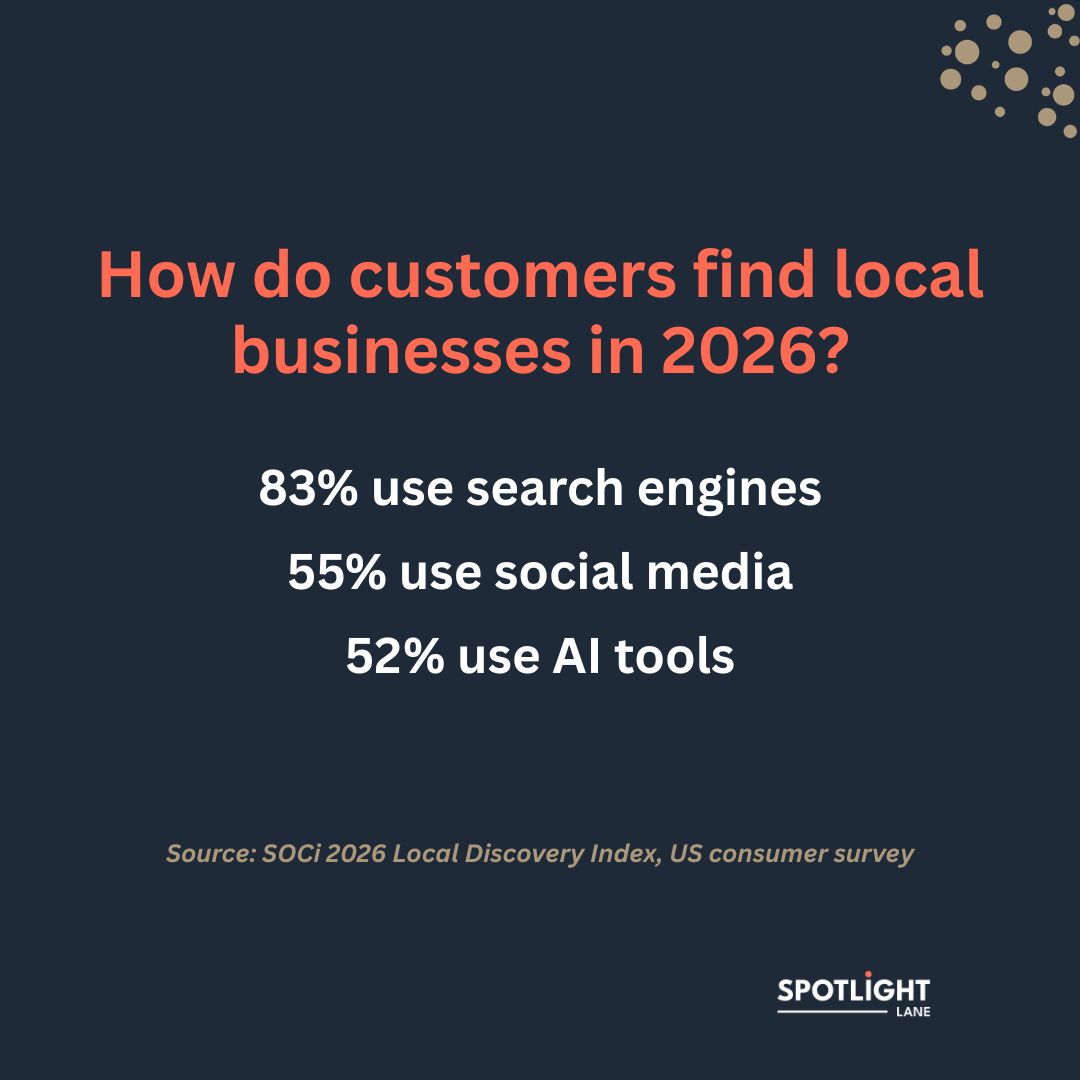
Despite all the conversation around AI and social search, search engines were still the most-used discovery channel in the study.
Of the consumers surveyed who had looked for a local business in the previous 30 days:
- 83% used search engines
- 55% used social media
- 52% used AI tools
As you’ll see, search engines are still a major part of how people find local businesses (phew, for me!), but they may not be the only place they look.
SOCi describes this as a “verification loop”. Someone might find a business through search, check its reviews, look at its social media and then make their decision. Or they might start with AI, Google the business afterwards and then look through Instagram to see how active they are before making contact. This is definitely the journey I take when looking at businesses.
So rather than one straightforward route from finding a business to becoming a customer, people are moving between different sources as they research and make their decision.
Facebook leads the way on social media for local discovery
The report also looked at which social platforms people use to find local businesses. Among consumers who use social media for local discovery:
- 73% use Facebook
- 69% use YouTube
- 67% use Instagram
- 50% use TikTok
For small businesses, you need to understand where your customers are actually spending their time and focus your effort there rather than spreading yourself thinly across every platform. For me, YouTube was the most surprising result, purely because I hardly ever use it to search for a local business.
Want to make a sale? Don’t ignore the stats for reviews and social media
The survey found that 99% of consumers read online reviews at least some of the time before visiting a business, while 43% use social media to get a feel for what a business or place is actually like. It also found that 59% had become a customer of a local business because of a social post or video.
I know there are many small businesses who feel like they’re talking into a black hole when posting on social media (including me) but just because someone doesn’t like, comment or message you there and then doesn’t mean they haven’t noticed you.
They might see one of your Facebook posts, remember your name, search for you on Google a few weeks later, read your reviews and then go straight to your website when they’re ready to enquire. This is really where multi-channel marketing comes in. It isn’t always one platform doing all the work; different parts of your marketing may be helping at different points along the way.
AI is part of the research for many, but do we trust it?
AI is now another part of that journey, but not always because someone has deliberately opened ChatGPT or Gemini. The survey found that 51% of consumers had encountered an AI answer at the top of Google results and 35% had used Google AI Mode, so people may already be interacting with AI as part of a normal Google search.
And it isn’t only younger consumers using it. Millennials led the way, with 63% having used AI to research a local business in the previous 30 days, but Gen Z and Gen X were almost level at 49% and 48%. Usage then dropped much more sharply among Boomers, at 11% (that tallies with my parents understanding of it!).
I’m using AI more for research myself now, so that doesn’t particularly surprise me, but I will still check what I’m being told elsewhere. The survey suggests other people are doing exactly the same.
Among consumers who had used AI, 67% said they had been given incorrect information about a local business at least once. And after receiving an AI recommendation, only 19% contacted the business directly. The other 81% checked somewhere else first, whether that was reviews, social media, search or several different sources.
So appearing in AI can get you onto somebody’s radar, but it doesn’t necessarily mean they are ready to contact you. They may still want to check that what they have been told stacks up elsewhere.
Different online marketing channels can do different jobs
We can spend a lot of time asking whether we should concentrate on SEO, social media or AI, when the customer may be using all three. That doesn’t mean every small business suddenly needs to be everywhere. I still think it’s better to choose the channels that make sense for your business and use them properly rather than spreading yourself too thinly. But it does mean we shouldn’t necessarily expect one platform to do everything.
SEO can help someone discover you when they’re actively searching for what you offer. Social media can show the people, personality and work behind the business. Reviews give reassurance from other customers. AI is becoming another way to research and compare. And your website can bring all of that together when somebody wants to understand more about you before making contact.
Give people a reason to choose you
There was another statistic in the report that I think is worth paying attention to: 63% of consumers said they had walked away when a business couldn’t provide the information they needed.
That’s an important reminder that getting found is only part of the job. Once somebody has discovered your business, the information they find on your website and across your other channels still has to give them enough confidence to take the next step.
And I think this is where the content itself becomes more important too. If your website isn’t expected to generate every customer through SEO alone, you don’t have to write every heading and every sentence around a search phrase. SEO still needs to be considered, but so does the person reading the page.
There’s so much generic content online now, particularly as AI makes it easier to produce more of it. If your website says the same thing as every other business offering the same service, it becomes much harder for someone to see why they should choose you.
Your website can still be optimised for search, but it can also have personality and useful information that actually sounds like your business. For me, that balance is becoming more important: helping people find you, without ending up sounding like everyone else once they arrive.
What this means for small businesses
The SOCi survey was carried out with more than 1,000 consumers in the US, so I wouldn’t suggest that these exact percentages represent every UK consumer or every type of small business. The research was also produced primarily with multi-location brands in mind.
But I think the behaviour behind it is true. People are using several sources to find out about businesses and build enough confidence to decide who they want to contact. Search engines are still playing a major role, social media and reviews help people form an opinion, and AI has become another part of the research process. They don’t all need to do the same job, but they can support each other.
So rather than only asking “Where should I be marketing my business?”, another useful question might be:
“Can customers find enough online to choose me?”
If you need any help with your website marketing, I’d love to help. Send me an email or call on 0115 971 3834
READY TO STEP INTO THE SPOTLIGHT?